Healer Anja knows little of politics but much of poisons. When she is summoned to treat the mysterious illness afflicting the king’s daughter, she finds herself against the clock, desperate to track down the source of the poison killing Princess Snow. But the chance discovery of a strange alternate world inside a magic mirror leads Anja to darker discoveries, including what really happened to Snow’s dead sister, Rose, and why their mother seemingly went mad and cut out her heart.
Aided by a taciturn bodyguard, a narcissistic cat, and a late Renaissance understanding of the scientific method, Anja must navigate the mysteries of the mirror world before the dark queen that dwells within rises to threaten them all.
When the King asks you to save his daughter, no is not an option. Healer Anja must leave her home and track down what, or who, is poisoning Princess Snow. It becomes clear that this is no easy task, and failing will cost more than she can spare.
The more Anja discovers, the more dangerous the task becomes. Even with the assistance of a stoic guard and an aloof cat, Anja doesn’t know if she will make it out alive.
I’ve done it again.
Somehow, I have accidentally read another Snow-White retelling. This one is partly on me, as one of the characters is literally called Snow.
I am not a fan of fairytales, so I find retellings boring. I don’t understand why this story couldn’t be independent from Snow White? It is different enough for that to be possible.
I am a bit surprised by the reviews. Anja, the main character, is okay but inconsistent. She is portrayed as perceptive, and at times she is, but is then dumbed down to suit the plot.
I appreciate Anja being older (35—I don’t think this is old but for a Romance-Fantasy, it is) and of a realistic build. This is depressingly rare in romance tropes.
Anja’s aversion to fashion is mentioned too often. I don’t understand why there is such an emphasis on women’s clothing in Fantasy. Regardless of the authors stance, all it does is reduce a woman to what she wears. If she doesn’t care about clothing, then why mention it at all?
Her friendship with the guard is jarring. Despite being a logical thinker, Anja would deliberately ignore or wilfully misread certain situations. Again, this is inconsistent and incredibly unrealistic.
For all I say about disliking fairytales, I did like Kingfisher’s approach. It is creative and unexpected. If it wasn’t for this, I would have stopped reading.
Overall, I wouldn’t recommend. I found it average, however, if you like fairytale retellings then maybe this is for you.
Click link below for Storygraph overview, which includes general rating, summary (same as above) and other reviews.
“What is it you think you’re protecting in that brain of yours? The war is over. Holdfast is dead. The Eternal Flame extinguished. There’s no one left for you to save.”
Once a promising alchemist, Helena Marino is now a prisoner—of war and of her own mind. Her Resistance friends and allies have been brutally murdered, her abilities suppressed, and the world she knew destroyed.
In the aftermath of a long war, Paladia’s new ruling class of corrupt guild families and depraved necromancers, whose vile undead creatures helped bring about their victory, holds Helena captive.
According to Resistance records, she was a healer of little importance within their ranks. But Helena has inexplicable memory loss of the months leading up to her capture, making her enemies wonder: Is she truly as insignificant as she appears, or are her lost memories hiding some vital piece of the Resistance’s final gambit?
To uncover the memories buried deep within her mind, Helena is sent to the High Reeve, one of the most powerful and ruthless necromancers in this new world. Trapped on his crumbling estate, Helena’s fight—to protect her lost history and to preserve the last remaining shreds of her former self—is just beginning. For her prison and captor have secrets of their own . . . secrets Helena must unearth, whatever the cost.
⭐⭐
Rating: 2 out of 5.
REVIEW
THEMES: FANTASY, EMOTIONAL, TENSE, DARK ACADEMIA, SLOW-PACED.
Helena Marino is a prisoner being held by the enemy she once fought against. She is imprisoned in the residence of the High Reeve who is notorious for his murderous rampages. Even though her records show she is nothing more than a healer, she possesses something they want. The issue is, it is hidden within her mind and neither they nor Helena can access it. Helena must dig deep to reveal what is being hidden within her, though that raises the question… is it hidden for a reason? And will uncovering it save or doom her?
TW: Sexual assault, gore, torture, intense violence and much more.
Does this book need to be this long?
No. It really and truly does not. This could have been 500 pages.
The plot of the story is strong; the settings are described in detail, and I could clearly picture every place described. There is no misconception that SenLinYu is a talented writer. There were multiple points where I was looking forward to coming back to the story.
Whilst I did enjoy aspects of the book, the characters fell entirely flat. Helena is a martyr and I cannot understand why she did the things she did. The characters SenLinYu were trying to push as ‘good’ never actually did anything to prove this narrative. There is also an inappropriate dynamic and I am displeased with how it unfolds.
I will go into more detail on my spoiler review; I have very strong feelings so brace for a rant.
In saying all this, I am not a big fan of ‘dark academia/fantasy’, so that definitely contributes to my rating.
From a fantasy reader (or just a reader), I would give this one a miss.
Click link below for Storygraph overview, which includes general rating, summary (same as above) and other reviews.
“What is it you think you’re protecting in that brain of yours? The war is over. Holdfast is dead. The Eternal Flame extinguished. There’s no one left for you to save.”
Once a promising alchemist, Helena Marino is now a prisoner—of war and of her own mind. Her Resistance friends and allies have been brutally murdered, her abilities suppressed, and the world she knew destroyed.
In the aftermath of a long war, Paladia’s new ruling class of corrupt guild families and depraved necromancers, whose vile undead creatures helped bring about their victory, holds Helena captive.
According to Resistance records, she was a healer of little importance within their ranks. But Helena has inexplicable memory loss of the months leading up to her capture, making her enemies wonder: Is she truly as insignificant as she appears, or are her lost memories hiding some vital piece of the Resistance’s final gambit?
To uncover the memories buried deep within her mind, Helena is sent to the High Reeve, one of the most powerful and ruthless necromancers in this new world. Trapped on his crumbling estate, Helena’s fight—to protect her lost history and to preserve the last remaining shreds of her former self—is just beginning. For her prison and captor have secrets of their own . . . secrets Helena must unearth, whatever the cost.
⭐⭐
Rating: 2 out of 5.
REVIEW
THEMES: FANTASY, EMOTIONAL, TENSE, DARK ACADEMIA, SLOW-PACED.
Helena Marino is a prisoner being held by the enemy she once fought against. She is imprisoned in the residence of the High Reeve who is notorious for his murderous rampages. Even though her records show she is nothing more than a healer, she possesses something they want. The issue is, it is hidden within her mind and neither they nor Helena can access it. Helena must dig deep to reveal what is being hidden within her, though that raises the question… is it hidden for a reason? And will uncovering it save or doom her?
TW: Sexual assault, gore, torture, intense violence and much more.
Does this book need to be this long?
No. It really and truly does not. This could have been 500 pages.
The plot of the story is strong; the settings are described in detail, and I could clearly picture every place described. There is no misconception that SenLinYu is a talented writer. There were multiple points where I was looking forward to coming back to the story.
Whilst I did enjoy aspects of the book, the characters fell entirely flat.
Rant incoming.
I remember once I saw someone say that women often have to prove their greatness, whereas men do not. Helena and Luke are perfect examples. Luke is described as this incredible and selfless person, yet I never really see it. Helena sacrifices herself to the point of becoming a martyr, just for a measly pat on the back. Luke is simply decent – which is rather easy when you are from a privileged family!
You are kind of beaten over the head with how selfless Helena is. It gets to a point where she is just naive. I could never relate to someone who will ruin themselves for people who could care less, so maybe that is why I dislike her.
There are other bland and unrelatable characters throughout the book, but these are things I can get past.
What I can’t get past is normalising abuse. Just because this book is set in a time of war, where everything is dark and dreadful does not mean you can minimise what Kaine does to Helena. Kaine literally beats Helena senseless, violates her and humiliates her for about 500 pages. These instances are ‘mitigated’ by the fact that Helena is persevering because she is secretly trying to gain his trust. Although, conveniently when the time comes to use this secret ammunition, she has grown too fond of him. Shocker. All of this is simply because he cried about his dead mum and got hurt by his own alliance. Apparently, this wipes away all his horrendous abuse. The kicker is that he justifies it by saying he was doing it all to deter her… as if it was for her own good. After this point, he is romanticized – or their relationship is.
This continues to spread the message; ‘Ladies, if he is horrible to you just try a little harder because at some point, he may reward you with affection!’ And its harmful.
What gets me the most, is in the end, he is made out to be this misunderstood and valiant person. He literally murdered hundreds of innocent people to find a woman who he treats as more of a possession than anything else. I felt violated reading as Helena slowly and reluctantly gave into his advances.
I also just found out that this is a Hermione-Draco fanfiction come to life. I am officially turned off.
Sidenote: Crowther reminded me of Little Finger from GOT.
I will end this rant, even though I have more to say, but I don’t want to come off as a complete buzzkill.
In saying all this, I am not a big fan of ‘dark academia/fantasy’, so that definitely contributes to my rating.
From a fantasy reader (or just a reader), I would give this one a miss.
Click link below for Storygraph overview, which includes general rating, summary (same as above) and other reviews.
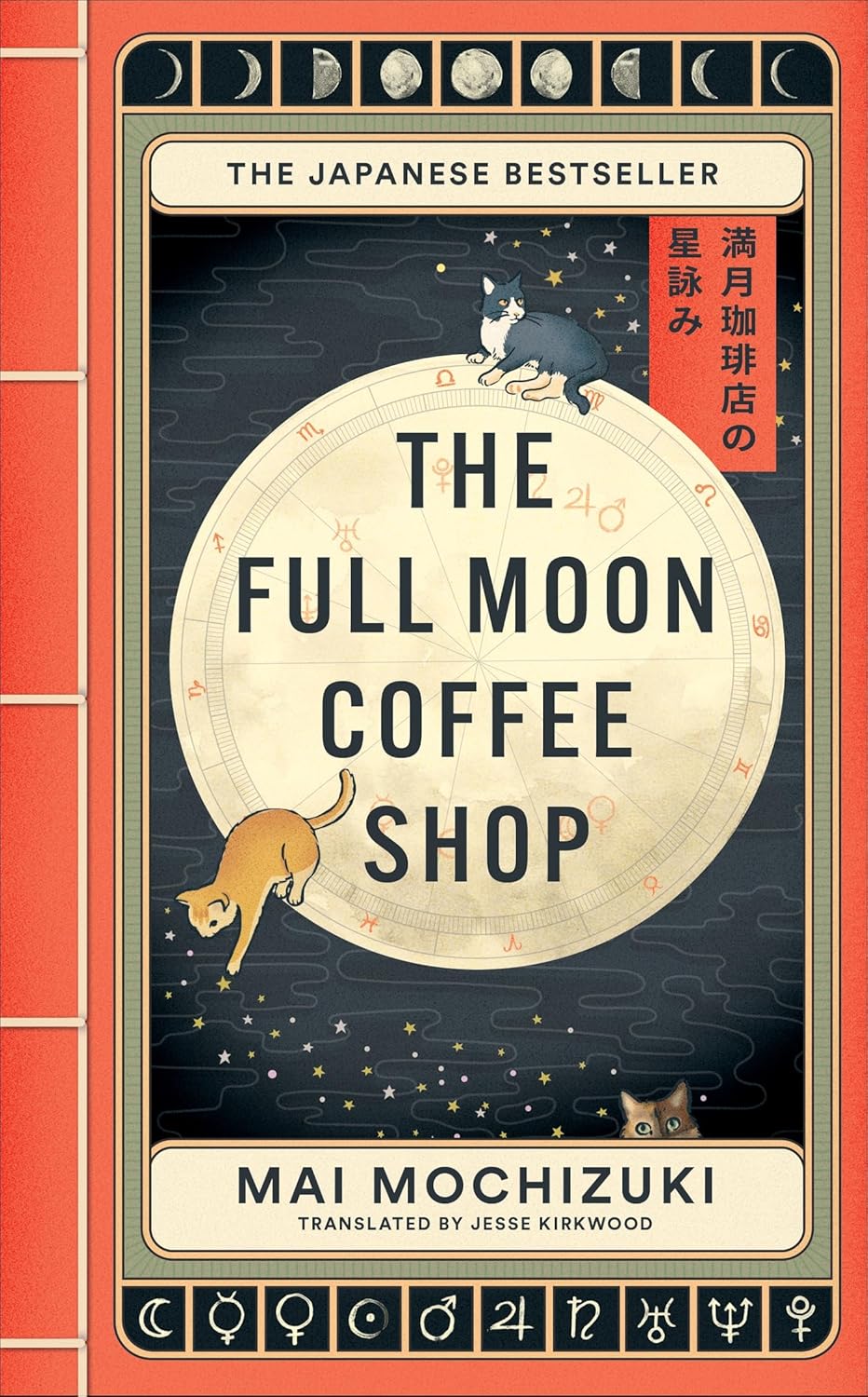
In Japan, cats are a symbol of good luck. As the myth goes, if you are kind to them, they’ll one day return the favor. And if you are kind to the right cat, you might just find yourself invited to a mysterious coffee shop under a glittering Kyoto moon.
This particular coffee shop is like no other. It has no fixed location, no fixed hours, and seemingly appears at random to adrift young people at crucial junctions in their lives.
It’s also run by talking cats.
While customers at the Full Moon Coffee Shop partake in cakes and coffees and teas, the cats also consult them on their star charts, offer cryptic wisdom, and let them know where their lives veered off course.
Every person who visits the shop has been feeling more than a little lost. For a down-on-her-luck screenwriter, a romantically stuck movie director, a hopeful hairstylist, and a technologically challenged website designer, the coffee shop’s feline guides will set them back on their fated paths. For there is a very special reason the shop appeared to each of them…
In the streets of Kyoto, there is a pop-up coffee shop that serves delicious beverages and desserts. The catch is, it only appears when someone needs it. As there is more to this eatery than just taste. When three lost souls stumble upon the cafe, they stop in for a bite to eat. Instead, they find guidance in the cafe’s servers…. who happen to be cats.
I found this book refreshing. With each storyline, Mochizuki does not go with the obvious solution. The characters are shown how to find peace in their lives, rather than focusing on the end goal.
I still remember each character, regardless of reading similar books since. This is due to the stories interlinking, which I found added to the reading experience. I was able to see each character in a different, and better light.
I am grateful to this book for getting me into the genre, but it is not my favourite. There is too much astrology talk, which at first, I tried to digest but could not in the end. It would only be interesting to someone with prior knowledge of astrology.
Super short chapters with sweet, insightful little stories. Would recommend to magical realism readers, cat lovers or astrology lovers.
Click link below for Storygraph overview, which includes general rating, summary (same as above) and other reviews.
1828. Robin Swift, orphaned by cholera in Canton, is brought to London by the mysterious Professor Lovell. There, he trains for years in Latin, Ancient Greek, and Chinese, all in preparation for the day he’ll enroll in Oxford University’s prestigious Royal Institute of Translation—also known as Babel.
Babel is the world’s center for translation and, more importantly, magic. Silver working—the art of manifesting the meaning lost in translation using enchanted silver bars—has made the British unparalleled in power, as its knowledge serves the Empire’s quest for colonization.
For Robin, Oxford is a utopia dedicated to the pursuit of knowledge. But knowledge obeys power, and as a Chinese boy raised in Britain, Robin realizes serving Babel means betraying his motherland. As his studies progress, Robin finds himself caught between Babel and the shadowy Hermes Society, an organization dedicated to stopping imperial expansion. When Britain pursues an unjust war with China over silver and opium, Robin must decide…
In childhood, Robin Swift was rescued from the impoverished streets of Canton by a mysterious, white benefactor named Richard Lovell. Lovell grooms him to become a student at Babel – Oxford’s renowned Royal Institute of Translation. Despite Robin’s passion for studies and years of enduring academic hardship – one meeting with a stranger completely alters his perception of everything around him. Robin realises that he has been attempting to function in a society that is actively working against him. This brings Robin to a tough decision, and once he chooses there is no going back.
I had no expectations going into this book, which was a mistake. When I pick up a Fantasy book, I expect it to be Fantasy first and foremost. Babel is a politically charged novel that features fantasy. Even though the entire plot is reliant on the Fantasy element, it still feels secondary to its exploration of colonialism and systemic oppression.
The dynamic between Robin and his friends is represented in a realistic manner. Kuang demonstrates how academic pressure, or general pressure can lead people act irrationally. Funnily, I did not feel anything towards any of the characters because of how unexceptional they were. Whilst this may sound like a critique, I actually think Kuang did a good job of representing friendships that readers have likely experienced.
I can’t say I loved the book. I feel Kuang could have made it a bit easier to read, even just with little changes like making the chapters shorter or the font bigger. Having a heavy book that is also dense with academic jargon made it hard to read at times. It felt like I was reading for years opposed to days. Though, not being prepared when going into it wouldn’t have helped.
I would recommend this to anyone who likes historical fiction, or fantasy shown in a practical manner.
Click link below for Storygraph overview, which includes general rating, summary (same as above) and other reviews.
In 2025, I read 68 books. My aim was 65, so I am rather pleased I was able to accomplish it. This year my aim is 75, or in other words, inevitable disappointment.
2025 has been an amazing year that has opened my horizons through the books I have read;
Fantasy has led me to herbology (The Poppy War, as well as most fantasy books) and etymology (Babel).
Japanese fiction has led me to writing – and writing with the correct tools (Letters from the Ginza Shihodo Stationary Shop).
And non-fiction has led me to animal behaviours and agriculture (Sapiens).
I have concocted a list of my top ten books of the year – a mix of fantasy/magical realism, contemporary and horror.
Rather than review the books, I will give a brief summary and then describe some elements I love about the books, but most importantly how they make/made me feel.
Loading…
10.
The Natural Way Of Things
Charlotte Wood
Released 2015, 320 pages.
The Natural Way of Things is a powerful story set in the Australian bush. A group of women wake up in the middle of nowhere, each as confused as the other. They are forced to endure hard labour and humiliating rituals. As the story progresses, their pasts come to light— hinting at the real reason they are trapped in this desolate prison. Author Charlotte Wood touches on the prevalent issues surrounding the patriarchy, focusing on the all-too-real experiences women face every day.
What I found interesting about The Natural Way of Things is how surprisingly un-bleak I felt whilst reading – or listening (audiobook). Although the actual subject matter is daunting, the characters were able to shift the narrative by demonstrating endurance and escaping the — pity. Wood’s descriptive, colourful writing painted a vivid image, allowing my imagination to takeover and absorb everything.
This book was not only a story, but a reminder of the society we live in. And whilst we may progress slowly everyday (in some countries), we must not forget those who suffer tomorrow, today and yesterday.
This story revolves around a bookstore owner named Yeongju and her Barista, Minjun, along with their customers and friends. Each character is facing a problem in their life, whether it is work, relationships or internal. As the story progresses, each of them is shown that the least likely of ventures can lead them exactly where they need to be. And all of them have one thing in common: The Hyunam-Dong Bookshop.
This is topical for me as I just completed ‘Every Day I Read‘, Hwang’s short memoir and collection of essays about writing and reading – review pending.
Welcome to the Hyunam-Dong Bookshop grew on me. At first, it felt like a carbon copy of books like, Days at the Morisaki Bookshop – but the key difference is the impact it had on me.
Hwang has such an approachable writing style, as though she is speaking with her readers. I have taken so much from this book – so much so – that I feel I should reread with a pencil in hand (a nod to Everyday I Read).
This book made me feel inspired, motivated and warm.
The Sailor Who Fell from Grace with the Sea follows a single mother, Fusako, and her son, Noboru. The dynamic between the two is complex and unconventional – which only becomes more bizarre once Fusako meets Ryuji, an experienced sailor. Noboru and his friends start to develop a set of expectations on how people should behave, and unfortunately Ryuji is not meeting that criteria.
I read more horror than intended last year and enjoyed more than anticipated.
The Sailor Who Fell from Grace with the Sea, explores some very disturbing themes which progressively worsen as the story goes on. Despite this, I still think of it often, somehow not perturbed by the creepiness.
Mishima’s descriptive, fluent writing style allowed me to glide through the book. Whenever I think to this book, I don’t have an exact ‘feeling’, I just remember how easily I read it.
The Eyes Are The Best Part is a story that follows Ji-Won as she experiences the trials and tribulations of what it is to be a Korean woman growing up in a western country (America). After her mother gets a new boyfriend, she starts to notice the striking colour of his blue eyes. Slowly this becomes an obsession, that leads to something far more sinister.
If I have learnt anything from horror this year, it is that I can only read from the antagonist’s perspective. It is too jarring reading from the victim’s perspective, as it forces the reader to become the victim.
That is why I love The Eyes Are the Best Part, which is the book that made me realise horror can be good. Kim has created a simple yet intriguing story that demonstrates the implications of gendered racism. She was able to find a perfect level of confusion and understanding – avoiding the predictable cliché of intense, ongoing mania.
This book made me feel surprised, captivated and satisfied.
Oh, and did I mention that this is her debut novel – her second novel Molka, will be coming out in 30th of April 2026.
Emilia and Vittoria are twin sisters who have grown up with warnings to avoid the Wicked. As witches, they must protect themselves from both supernatural creatures and humans alike.
Though they are twins, Emilia and Vittoria couldn’t be more different. Vittoria is cynical and fiercely independent, while Emilia is gentle and content to spend her days experimenting with new recipes and cooking for her family’s Sicilian restaurant.
All of a sudden, a string of murders begins to unfold around town — each victim a witch, each killing marked by the same eerie signs.
To Emilia’s dismay, Vittoria goes missing. Her disappearance ignites something in Emilia, driving her to search for answers at any cost. But will she continue down this path when the truth leads her to her most feared enemy — Wrath, one of the Seven Wicked Princes of Hell?
I read four fantasy series/trilogies this year, and this was my definitely favourite. Maybe it wasn’t the most highbrow, and there may be a good dose of corny material, but it was exactly what I needed at the time I read it.
I may be cheating by having an entire series under one number, but it’s my blog, so, my rules. It also includes all of the Prince of Sin series as well, whilst I’m at it.
I adore the ‘Princes of Hell’ concept. I was immersed throughout the entire series and thoroughly enjoyed every page. I actually liked the main characters and Maniscalco was able to catch me off guard a couple times.
This book made me feel excited, anticipatory and happy.
I go in more depth about the Kingdom of the Wicked and Princes of Sin reading order on this post.
Throne Of Nightmares coming out 10th of February.
5.
Katabasis
R.F Kuang
Released 2025, 541 pages.
Alice Law and Peter Murdoch, academic rivals – must journey to hell to retrieve their professor’s soul – after his unfortunate death caused by a ‘freak’ accident. Though, shockingly, it is not a walk in the park – the two must overcome their past and learn to work together, otherwise everything will go to…
I have read The Poppy War series and Babel, and this is undeniably my favourite book from Kuang – which may be controversial.
Katabasis is academic, intriguing and surprisingly romantic.
I feel like I have a love-relationship with Alice. Kuang has a special ability of bringing out the worst in her characters yet making you inexplicably (maybe even begrudgingly) love them.
The concept of venturing to Hell is right up my alley- as mythology is a keen interest of mine. Having two know-it-all scholars, essentially ‘nerd-off’ by debating the physics of hell, is comical. The one unexpected element I noticed whilst reading – which I haven’t seen in other reviews – is the dry humour. I was laughing throughout the entire story.
This book made me feel excited, tense and, joyful?
Greta is a transcriber for a sex therapist in her hometown. Day in and day out she listens to the secret intimacies of the people who live around her. Despite their identities being kept anonymous, she can identify them simply by their voice. One day, a client – Greta refers to as ‘Big Swiss’ -catches her attention. She is drawn to her cavalier, frank demeanour and enigmatic voice – so much so that she becomes enamored.
Whilst walking her dog at the park, she hears that familiar voice. She goes and introduces herself with a fake name, not knowing this would lead to a bond like none she has experienced before.
I think the blurb/overview of this book is somewhat misleading. Whilst there are sensitive subjects covered, it did not feel sinister or heavy.
There are multiple reasons for this; Beagin’s remarkable writing style – with frequent insertions of dry humour and witty quips, coupled with Greta’s unflappable outlook on life.
This book really struck me, because it made me realise that perspective is absolutely everything. Whilst this may seem obvious, it is one of those facts I knew of but did not conceptualize until reading the book.
Big Swiss had a quiet impact on me; I did not know I would be placing it so high on this list, until I started constructing it.
This book made me feel surprised, tense (at moments), and it made me laugh – not out loud, but with a smirk of appreciation.
Working in the fields, Emmett Farmer lives a simple life tending to his family’s farm. One day he is sent a letter offering him an apprenticeship as a Bookbinder – a vocation that is frowned upon within the town he resides. Due to unexpected circumstances his parents have no choice but to send their son to the feared Bookbinder, Seredith.
Bookbinding is a profession that requires the most unlikely of skills, the ability to transfer and trap memories into a book. If Emmett does not learn this craft, it will cost him his sanity.
The books are discreetly hidden behind a vault, the key around the neck of his mentor. One day, he finds himself in the safe and makes the discovery that one of the books, has his name on it.
This book was sitting on my bookshelf for ages, until I begrudgingly picked it up.
The Binding is split into three parts. Whilst it did take me until half-way-through part one to get into it, I am sincerely glad I persevered.
The concept of the book is interesting, and Collin’s execution of it is incredible. The layout of parts one, two and three are perfection – I do not believe there is a better way it could have been told. It is also split into perspectives, which I find refreshing, as it allows for a better understanding of what is happening.
It is tricky to pinpoint what I love about this book, for fear of spoiling, so…
It made me feel exhilarated, intrigued and utterly immersed.
2.
What You Are Looking For is in The Library
Michiko Aoyama
Released 2020, 245 pages.
Characters from all walks of life, with an array of different personal problems are led to a community library. They are greeted by a peculiar woman, named Sayuri Komachi, who has a knack for felting. To their confusion, she gives them each a book they didn’t ask for. Little do they know, these books will help them in an unexpected, yet extraordinary way.
I think I would be personally offended if someone told me they didn’t like What You are Looking for is in The Library. I can understand it not resonating, but to not have enjoyed it, is criminal.
What stood out in this book, is how established the characters are. I have read books similar, and whilst they are good, they lack character depth. Somehow, Aoyama has managed to create five, interesting and independent characters, in 245 pages, split into five parts.
The concept is endearing, and it has made a genuine impact in my life. It instilled motivation in me that has not left. I am now going out and doing all the activities I have been putting off, simply from reading this book.
This book made me feel motivated, reflective and joyful.
1.
The Song Of Achilles
Madeline Miller
Released 2011, 378 pages.
Patroclus, son of King Menoetius, is exiled to the court of King Peleus due to unfortunate circumstances. Whilst Patroclus is awkward, scrawny and timid, – Achilles – son of King Peleus, is the perfect Prince who is admired by all who meet him. Achilles and Patroclus find friendship in their differences and form a strong bond, growing together and becoming young men skilled in the art of war – despite the objections and meddling of Thetis, the cruel Sea Goddess and Achilles mother.
Unexpectedly, it is reported that Helen of Sparta has been kidnapped and must be rescued. Patroclus for fear of losing his beloved companion, follows Achilles to Troy. What was originally a straightforward plan turns into something much more, where all they hold dear will be tested.
Words cannot describe how much I adore this book. The title alone makes me feel all the emotions.
The writing is impeccable, it is sacred, it is my bible. If The Song Of Achilles was a religion, I would worship it. The characters are loveable, hateable, perfect, flawed and devastating.
I recommend ignoring the blurb – go into it completely blind (the overview I have written is spoiler-free). Then afterwards, listen to Hozier. Thank me later.
Alice Law has only ever had one goal: to become one of the brightest minds in the field of Magick. She has sacrificed everything to make that a reality: her pride, her health, her love life, and most definitely her sanity. All to work with Professor Jacob Grimes at Cambridge, the greatest magician in the world.
That is, until he dies in a magical accident that could possibly be her fault. Grimes is now in Hell, and she’s going in after him. Because his recommendation could hold her very future in his now incorporeal hands and even death is not going to stop the pursuit of her dreams….
Nor will the fact that her rival, Peter Murdoch, has come to the very same conclusion.
But Hell is not like the storybooks say, Magick isn’t always the answer, and there’s something in Alice and Peter’s past that could forge them into the perfect allies…or lead to their doom.
Alice Law and Peter Murdoch, academic rivals – must journey to hell to retrieve their professor’s soul – after his unfortunate death caused by a ‘freak’ accident. Though, shockingly, it is not a walk in the park – the two must overcome their past and learn to work together, otherwise everything will go to…
This is my fifth book written by R.F Kuang (only Yellowface to go), and she surprises me every time. Last year I was really into mythology after reading The Song of Achilles and listening to Hozier, so to find out she would be writing a Dantes Inferno-esque book, I was ecstatic.
I love this book, it is interesting, well-written and funny. Surprisingly, I have not read one review that mentions her quiet, humorous remarks – which adds a light-hearted aspect to an otherwise intense novel.
The plot itself is immersive, detailed and chaotic – yet somehow structured. In typical Kuang fashion, it is methodically researched, with considerable depth to the magic system – and the math and science behind it. Not to mention the elaborate descriptions of the paradoxes and pentagrams.
I love Kuang’s unique approach to hell, it is definitely a concept that has been done to death (pun intended), so it was interesting reading her take on it. (In saying that, I have not read that many ‘hell’ books.)
As per usual, Kuang does not write her characters to be liked but to be humanised. I went through periods where I would hate Alice because of her contradictory, self-righteous disposition – but then I would realise she is hateable because she is relatable. Her complex relationship with Grimes is suffocating – the rage and exasperation I felt whilst reading was constant.
Kuang masterfully depicts the struggles a Chinese woman would face in a (white) male dominated institution. I also like how she touches on internalised misogyny, which can be tricky to portray as realistic, whilst remaining tasteful.
My disappointment is that the setting did not feel overly specific to hell, I would have enjoyed more of an incorporation of hell’s lore.
I would recommend anyone try this book, especially fantasy readers. I think Katabasis definitely showcases Kuang’s range and is a really good stepping stone into her weightier reads.
Click link below for Storygraph overview, which includes general rating, summary (same as above) and other reviews.
It is about time I create a list of Book Slump books, considering the name of my blog.
So, I have compiled a list of books that will (hopefully) get you out of your Book Slump. In other words, I found these book easy to read.
I have done one for almost each genre. Any genre that I have missed is either because I have not read from it or I have not ready anything ‘easy’ from it.
Enjoy!
Loading…
FANTASY
Kingdom Of The Wicked
Kerri Maniscalco
Emilia and Vittoria are twin sisters who have grown up being warned to avoid the Wicked. As witches, they must protect themselves from both supernatural creatures and humans alike.
Though they are twins, Emilia and Vittoria couldn’t be more different. Vittoria is cynical and fiercely independent, while Emilia is gentle and content to spend her days experimenting with new recipes and cooking for her family’s Sicilian restaurant.
All of a sudden, a string of murders begins to unfold around town — each victim a witch, each killing marked by the same eerie signs.
To Emilia’s dismay, Vittoria goes missing. Her disappearance ignites something in Emilia, driving her to search for answers at any cost. But will she continue down this path when the truth leads her to her most feared enemy — Wrath, one of the Seven Wicked Princes of Hell?
Before I begin, I implore you to read book one without context – I feel like the blurb spoils too much. What I have written above excludes the spoilers.
PRINCES OF SIN READING GUIDE
Kingdom Of The Wicked trilogy
Throne Of The Fallen
Throne Of Secrets
Throne Of Nightmares [expected February 2026]
To preface, I recommend all of the Princes Of Sin book. However, you must read them chronologically to avoid spoilers – despite there being standalones. I made this mistake – by accidentally reading Throne Of The Fallen first -and it spoilt the ending of Kingdom Of The Wicked for me.
I love this trilogy; it actually got me out of my most recent Book Slump. If you enjoyed; Crescent City or The Gods and Monsters series, then you will definitely love this. Having my most recent reads be classics, I desperately needed this palate cleanser.
In some of the fantasies I have read, the main characters become insufferable because they never learn from their ignorance. They keep making the same mistakes repeatedly, and act like victims when it doesn’t pan out – it makes me want to scream, I hate it so much. Thankfully, the characters in this trilogy were appropriately ignorant and rarely made the same mistake twice (don’t quote me on that). It honestly caught me off guard, when a situation arose where there was an opportunity for idiocy, the characters did the opposite of what I assumed, which is refreshing.
Maniscalco manages to find the perfect balance of predictability. At times, I was able to foresee outcomes but was equally in the dark at others. I absolutely adore the Princes of Sin concept and am so glad she has stuck with it.
I find Emilia’s point of view amusing. She has flaws but never became overbearing or unrealistic – she actually reacted satisfyingly when she was treated unfairly. Though, it would have been great to read from other characters point of views – which she has since changed in her Prince of Sin standalone ‘series’.
All in all, it is so perfect for the Halloween season and will keep you engrossed. I stayed up till four am, at least three times when reading this trilogy. I have since, begrudgingly, put measures in place to avoid this.
ROMANCE
The Seven Year Slip
Ashley Poston
Released 2023, 328 pages.
As a publicist, Clementine works overtime to get the job done. Though, it is not solely for career progression, but to protect her heart. Using work as a shield, Clementine has cut herself off from love and refuses to embrace it fully.
One day, she comes home – formally her late aunt’s apartment – to find a stranger standing in her kitchen. He is sweet, charming and charismatic, someone she could fall for under the right circumstances – which, unfortunately these are not – because he lives in the past… seven years to be exact.
Her aunt always spoke of this phenomenon, but Clementine brushed it off, assuming her aunt was making up stories – which was in keeping with her wild, adventurous personality.
It becomes difficult for Clementine to separate the past and present, whilst also being haunted by the memory of her aunt, whom she loved dearly.
Can this mysterious man break down her carefully constructed walls and show her true love or will she shield herself, like she always does?
Full disclosure, I have not read much normal romance, as I typically stick to romance within fantasy. Other than Alone With You in the Ether (which is not light), my frame of reference is a bit off. Though, this could work in my favour, since I found this an ‘easy’ read, I can speak from an inexperienced point of view – whereas a romance buff may have higher standards and find this book too light.
Anyway, I enjoyed the concept of this book – especially as someone who loves fantasy, having some magical realism helped ease the transition. I found it really easy to get into – actually, I believe I finished it in one day, now that I think about it.
Fair warning, the dialogue is diabolically cringe, like the worst of the worst – though, you probably gathered that if you have read the blurb. I audibly gagged at a couple of the conversations. It got to a point where I was praying Poston was being satirical – but devastatingly, I doubt it.
I cannot confidently compare it to any books, due to my inexperience. However, there is overwhelmingly positive reviews for the book, hence why I read it – so to put it in Fantasy terms, it may be the Serpent and the Wings of Night of romance (please, do not quote me on that).
The story is super light, the romance is prevalent, the intimate scenes are tame, and the plot is fun. I think it is perfect for a book slump or a palate cleanser in-between books. If you are someone who likes romance that is heavier, with realistic dialogue and substantial characters, then I would keep looking.
HORROR
Perfume
Patrick Süskind
Released 1985, 263 pages.
Since infancy Grenouille has had one notable quality, he has no personal odour – but ironically, has the best nose in Paris and can distinguish a smell off a few inhales.
Grenouille goes through life as an unremarkable man, that nobody notices. Though, this works to his advantage because one day, he smells something so incredible that he becomes obsessed.
I have been trying to get into more classics this year, and Perfume has decisively good reviews – and I concur, as it is in my top three.
The story centres around Grenouille and is set-in eighteenth-century Paris, which is described as a crowded, foul-smelling city. It starts off on bleak circumstances, setting the story up on a miserable note, which makes sense, but is misleading. Despite the grim topic, I was able to look past it because of the writing style.
Süskind has a way of making his readers question their own morality – because whilst the subject matter is perverse, having it written from the antagonists’ perspective changes the whole perception of the story. I found myself excusing Grenouilles sinister hobby, because of his frank, almost innocent outlook.
For me, the first part is a little slow. As it is predominantly setting up the story and was relatively tame (for a horror). What made me like the book was the second half, especially the ending. So, if you find yourself bored at the beginning, just push through – to me the ending makes it worth it.
If you enjoyed The Vegetarian by Han Kang, then I think you’ll enjoy this, and vice versa. As The Vegetarian also explores the themes of morality, and how perspective makes a significant difference to how a story can be perceived.
I would recommend this to any horror readers, especially if you are looking to get into the classics.
CLASSIC
The Alchemist
Paulo Coelho
Released 1988, 182 pages.
Santiago, an Andalusian shepherd boy, is content on travelling from town to town in his homeland, making money off of his sheep.
One day, he is approached by a mysterious man claiming to be a King. He says that Santiago is destined to find great treasure, and that he must descend on his own personal journey to locate it.
After some convincing, Santiago decides to follow the king’s urgings and embark on this adventure. Along the way, he meets some unusual characters and visits some interesting places – though it will not all be easy. By having to overcome great hardships, Santiago has to decide whether he can continue on this journey or if he will resort back to his comfortable life.
Paulo Coelho’s The Alchemist is more of a self-discovery journey than anything else. With life lessons woven throughout the story, Coelho explores spirituality and the importance of signs. Each character plays an important role in the story and in Santiago’s life, serving their purpose — whether it’s to create an obstruction or provide helpful guidance.
The story is easy to get through, with a consistent plot and practical characters. The Alchemist explores the unpredictability of life and how everything serves a purpose — even if it’s not clear at the time.
Whilst I am recommending it, it is not my favourite classic. However, it is easy to read, unlike some of my preferred classics, which are too intense for a book slump.
The main deterrent is how religious the book is throughout. I’m not a religious person, so I found it difficult to relate to — and I had high expectations due to the rave reviews, which I don’t feel it fully lived up to.
I haven’t read many classics like The Alchemist, but if you enjoy Japanese fiction like Before the Coffee Gets Cold or Days at the Morisaki Bookshop, you may like this — as they too explore the theme of self-discovery and the idea that everyone has their own personal journey.
As mentioned above, I would recommend The Alchemist to anyone seeking a book about self-discovery or personal inspiration. Those with a religious background may also find deeper meaning in the story. Additionally, I believe it would make a great novel to read to children.
HISTORICAL
Lessons in Chemistry
Bonnie Garmus
Released 2022, 400 pages.
Elizabeth Zott, Chemist at Hasting’s research, must endure the scrutiny of being the only woman in a male-dominated field. Left to do all the grunt work, Zott must fight for her job, as the alternative is being fired.
One day, Zott meets Calvin Evans — a Nobel Prize–nominated chemist known for his reserved and brusque nature. Being hard-headed and combative herself, Zott has finally met her match. After some time, they – unsurprisingly – begin to the date – to the dismay of their fellow colleagues.
Unfortunately, life does not go to plan, and Zott must upheave her life due to unexpected circumstances. This leads to her (begrudgingly) hosting a TV show called Supper at Six.
Zott’s unorthodox approach to cooking captures the attention — and hearts — of women around the state. Despite the success of the show, Zott faces the hardships of being a woman in the spotlight. Her radical disposition challenges the social standards of what it means to be a woman — and not everyone likes it.
I have excluded the spoilers in my description above; however I advise ignoring any other overview of the book as, I think, it spoils too much.
Lessons in Chemistry is one of those books I assumed would be boring, because it is part (normal) romance and part historical fiction, based in America. Those are two things that do not particularly interest me — though this year, this book (among many others) has taught me that it’s not the content of a book, but the way it is written.
If there was one word to describe Elizabeth Zott, it would be resilient. Garmus has created a beautiful character who is relatable with a dry and witty demeanour. I felt inspired by her; whenever she would receive unfair treatment, her response would be skilfully void of emotion. She aggravates other characters by being factual and rarely allows emotion to lead her in arguments.
Initially, I was frustrated by the romance. To have a book be about societal and patriarchal struggles and then include romance, feels a bit reductive. However, Garmus executes it beautifully. Whilst there is romance, it does not overpower the plot.
This may be contrary to popular opinion, but I hate the TV adaptation. It is so different to the book. I think Brie Larson was a perfect choice for the role of Zott, but the plot fell flat. They removed key parts of the book and added other elements which — whilst important — felt forced. I think they could have found a way to stay closer to the original script and still include the additional events without changing the trajectory of the story.
I haven’t read anything quite like Lessons in Chemistry in terms of plot, but if you like established female characters like the ones in Big Swiss or The Rook, then I think you’d enjoy this.
I would recommend this book to anyone, really. Naturally, if you’re interested in feminist literature or historical fiction, then definitely give it a go. But I think this is a book that anyone could enjoy.
NONFICTION: MEMOIR
Red Sky
Minzhi Xing
Released 2023, 218 pages,
Embark on a powerful journey of courage and resilience with Red Sky. This story is set in Mao’s Red China and explores the effects of the Cultural Revolution on a family. Follow Minzhi Xing as she navigates her way through the tumultuous times of Mao’s Red China, from being separated from her family for 10 years, to ultimately reconnecting with the strangers that were once her parents. Feel the power of perseverance through Minzhi’s story and be inspired to overcome whatever obstacles may come your way!
The overview above is from StoryGraph. Since I read this a while ago, I didn’t want to risk misrepresenting the book. Red Sky isn’t a widely read book, and because I borrowed it from the library, I can’t do an extensive recall — but I’ll try my best.
What I remember most about this book is Xing’s writing style. She writes as if she’s speaking to you, not down to you. She explains events in a simple yet informative way. Historical non-fiction can often be dense, filled with complex terminology — so being able to understand everything, without having to whip out a dictionary was refreshing.
It’s impressive how much of her life she can recall- I struggle to remember anything prior to the age of ten (if that).
Even though Xing wasn’t directly affected by Mao’s regime in the same way her parents were, she beautifully describes the devastating effects of his rule and the persecution of those who opposed him. She also shows how Mao’s leadership impacted China economically and socially the years after, as she grew up.
Red Sky is a beautiful and compelling story that I highly recommend to anyone interested in Chinese history, general history, or memoirs and biographies. It is also perfect if you are looking to get into non-fiction, as it is not full-on.
Misery Lark, the only daughter of the most powerful Vampyre councilman of the Southwest, is an outcast—again. Her days of living in anonymity among the Humans are over: she has been called upon to uphold a historic peacekeeping alliance between the Vampyres and their mortal enemies, the Weres, and she sees little choice but to surrender herself in the exchange—again…
Weres are ruthless and unpredictable, and their Alpha, Lowe Moreland, is no exception. He rules his pack with absolute authority, but not without justice. And, unlike the Vampyre Council, not without feeling. It’s clear from the way he tracks Misery’s every movement that he doesn’t trust her. If only he knew how right he was….
Because Misery has her own reasons to agree to this marriage of convenience, reasons that have nothing to do with politics or alliances, and everything to do with the only thing she’s ever cared about. And she is willing to do whatever it takes to get back what’s hers, even if it means a life alone in Were territory…alone with the wolf.
Getting into the Halloween spirit, I thought it would be fitting to review a werewolf-vampire fantasy. It is also topical, considering book two of the ‘series’, Mate, was recently released.
What I love about Bride is that Hazelwood has established her voice in her writing; she is humorous, witty and down to earth.
I found myself relating to Misery, as she would make humorous remarks that would echo my thoughts and feelings. This connection made the story even more engaging.
Whilst I have read plenty of fantasy books with interesting main characters – Hazelwood has a way of channelling herself into her characters, granting them their uniqueness – which is a rare talent. Her interviews and her general online presence, proves this to be true, in my opinion.
The plot is interesting – arguably a bit unoriginal – but Hazelwood is able to build-off the familiar concept and make it her own. There was an appropriate level of drama in the books, I did not feel overwhelmed or bombarded – which can happen (sometimes) in standalone novels.
Fair warning, there are certainly some aspects of the book, that may force you to take a moment and stare at the wall. Hazelwood has a reputation for her sultry writing and unusual… tastes.
I recommend this book to anyone looking for a light, enjoyable read — especially Romance/Fantasy readers or those wanting a gateway into contemporary romance. Since Hazelwood predominantly writes in that genre, Bride is a fun crossover with a familiar voice.
Click link below for Storygraph overview, which includes general rating, summary (same as above) and other reviews.
“The body you are wearing used to be mine.” So begins the letter Myfanwy Thomas is holding when she awakes in a London park surrounded by bodies all wearing latex gloves. With no recollection of who she is, Myfanwy must follow the instructions her former self left behind to discover her identity and track down the agents who want to destroy her.
She soon learns that she is a Rook, a high-ranking member of a secret organization called the Chequy that battles the many supernatural forces at work in Britain. She also discovers that she possesses a rare, potentially deadly supernatural ability of her own.
In her quest to uncover which member of the Chequy betrayed her and why, Myfanwy encounters a person with four bodies, an aristocratic woman who can enter her dreams, a secret training facility where children are transformed into deadly fighters, and a conspiracy more vast than she ever could have imagined.
Funnily enough, I wouldn’t have picked this book for myself, it was a gift, which I (initially) begrudgingly read. Immediately I was engrossed. Ironically, I had judged a book by its cover and have never been so happy to be wrong.
When I adore a book, it can be difficult to identify all the reasons why. Partly because my reasons are backed by emotion and partly because I sometimes struggle to pin them down – but I’ll try my best.
O’Malley’s writing is sensational. The premise of the story is genius, following along as the protagonist figures out who she is and what happened to her was a captivating experience.
Whilst the story is complex, where readers have to learn new terms, supernatural abilities and characters – O’Malley explains everything in a simple yet concise manner, dropping clues and justifications along the way.
The characters are clearly well thought out, each of them has a unique ability/personality that unfolds as you read. A lot of creativity and planning must go into making these characters and I am really glad it shines through in the writing.
Not that the bare minimum deserves praise, but Myfawny is written in a respectful way. She has realistic complexities, and I thoroughly enjoyed her dry persona and humorous observations.
I do not just recommend but beg you give this a go, I look forward to completing the series… especially since the Royal Gambit (Book four) was released this year.
Click link below for Storygraph overview, which includes general rating, summary (same as above) and other reviews.